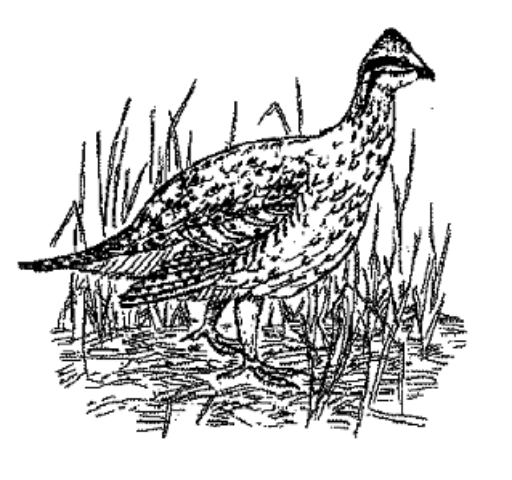
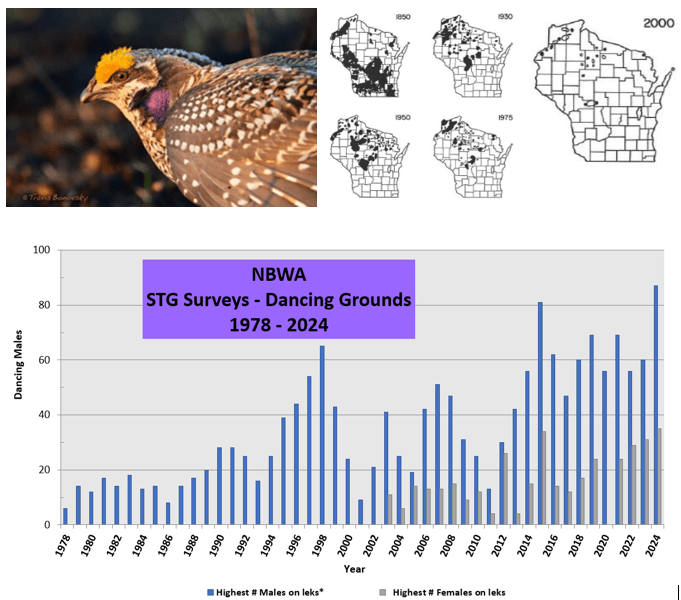
Welcome to the Namekagon Barrens Wildlife Area (NBWA), home to sharp-tailed grouse and a beautiful, globally rare habitat. This population of Wisconsin sharp-tailed grouse has been increasing and becoming more stable over the last dozen years since securing and improving more habitat, but efforts must continue to maximize mating and brood success.
Recent Minnesota DNR research documented less mating behavior at leks when viewers arrived later or left earlier than recommended, compared to when people followed protocol.
All users must agree to this Protocol to reduce disturbances during mating and to keep viewing blinds open to the public. Only visitors that sign and agree can reserve a blind.
Thank you and enjoy the show!
Nancy Christel (wildlife biologist)
715-645-0072
- NEW 2026 Lek Locations: Final Sharp-tailed Grouse Viewing Lek Locations & Directions 2026 updated by March 31st. Follow directions to minimize lek disturbances.
- No driving through the property because birds attempting to establish leks on firebreaks are being disturbed. Interior trails are mistaken for roads and incorrectly identified on GoogleMaps and OnX. If a drivable surface is identified as a Road, you may drive on it. If it is unnamed or identified as a Fire Lane (Gomulak, Clemens and Delong/Lien), public visitors may not drive on it.
- For handicap access permission, contact Nancy Christel 715-645-0072.
- Be in the blind at least 45 minutes before sunrise, the earlier the better. Females are less likely to return when flushed after sunrise.
- Remain in the blind until the birds leave on their own at the end of the display period, typically 2-3 hours. When birds are flushed by a predator and it is still early, expect they will return within several minutes. Be quiet and move slowly while in the blind.
- When you leave, gather all your items, close the door and windows, and leave quickly and quietly in case they wish to return to the lek.
- Complete the survey and leave it in the blind. Males display an orange eye comb and a violet throat patch when they dance. Females do not dance and lack the eye comb and throat patch. Males often dance in pairs; females visit.
My reservation party and I will follow the above protocol because we value healthy, sustained populations of sharp-tailed grouse and want to keep viewing blinds available.
Use this link to reserve a blind and agree to follow this pledge.